9 Mothers Launches Autoturret to Shoot Down Drones
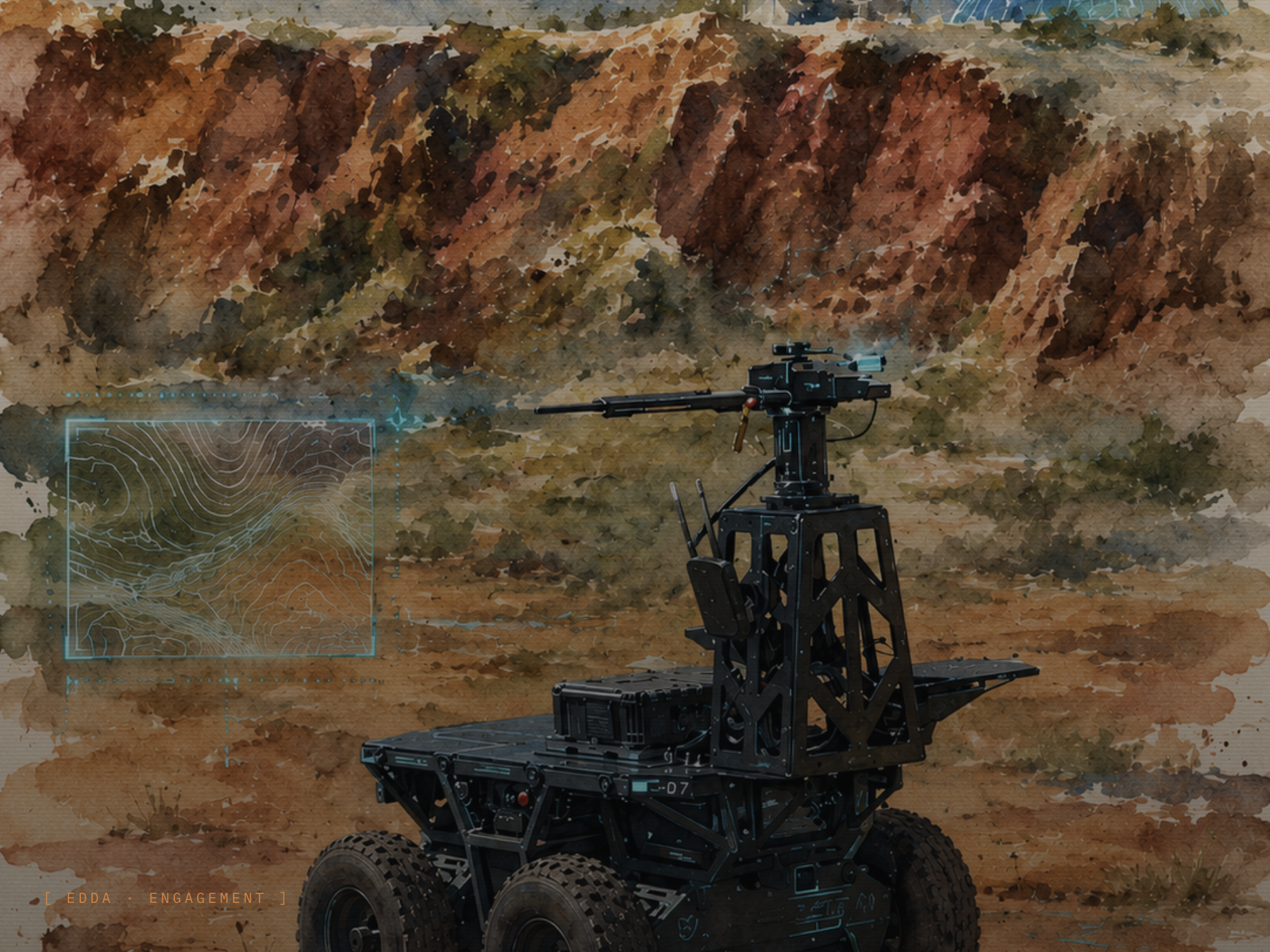
9 Mothers (9mothers.com), a YC P26 company building AI mission systems for the Department of War, has come out of stealth with EDDA, a 23-kilogram autonomous turret designed to shoot down high-speed FPV suicide drones at close range. The company is backed by Pioneer Fund, Rsquared, Y Combinator, and other investors.
The problem 9 Mothers is attacking is urgent. Cheap, first-person-view attack drones, often assembled for a few hundred dollars, have become the single largest source of casualties in active conflict zones like Ukraine. They fly at speeds around 30 m/s, swarm in volume, and engage at distances as close as 50 meters. Legacy counter-drone systems were built for an older threat profile: large, slow, RF-emitting platforms at kilometer-scale ranges. They are too heavy, too expensive, and too slow for what's actually happening on the battlefield.
EDDA is the company's answer to that gap. It uses passive acoustic detection to pick up a drone's intrinsic sound signature, then hands off to a proprietary onboard visual model for fine tracking, including through occlusion. The system emits zero RF, making it invisible to electronic surveillance. Its motion platform can slew 5 degrees in under 15 milliseconds with 1.5-arcminute precision, paired with a shotgun effector designed to engage small drones at 10 to 100-plus meters. The whole package fits in half a cubic meter.
"EDDA defeats fast Group 1 threats that fielded systems consistently miss. Operators evaluating it have told us it's the only system that's stopped fast Group 1."
The company says it already has multiple government contracts and has sold and delivered systems. The U.S. government and its prime contractors are among its buyers.
Co-founder Russell Smith previously co-founded Rainforest QA (YC S12), which raised $60 million and grew into a widely used QA testing platform. He started 9 Mothers with co-founders Roman Khomenko and Bogdan Pyzh after watching the mounting toll of suicide drones in the Russia-Ukraine war and concluding that existing counter-drone approaches, particularly those reliant on RF jamming and electronic warfare, were fundamentally inadequate against the current threat.
EDDA is the first of four planned products spanning a single kill chain. The company has also announced Vor, a passive acoustic sensor; Atla, a belt-fed shotgun system for sustained swarm engagements; and Gleipnir, a system targeting larger Group 2 drones and one-way attack munitions like the Shahed, with a cost-per-shot under $10,000. Vor and Atla are expected in Q1 2027, with Gleipnir following later that year.
The team is based in Austin, TX and is currently hiring across a dozen engineering roles, from machine learning and computer vision to mechatronics and embedded systems.